Start with charging access, then compare the cars you can actually buy. A strong hybrid can suit stop-start driving without a plug; an EV is worth considering when charging fits your routine. A PHEV needs regular charging to make good use of its electric capability. A mild hybrid remains an engine-led car with electrical assistance. None is the automatic winner for every Indian buyer.
This guide helps you shortlist a powertrain before choosing a model. It does not rank individual cars or promise a fuel-saving payback. Manufacturer pages were checked on 2 October 2026; confirm the exact India variant and written quotation before booking.
A decision tree for your driving and parking
- Can you reliably charge where you park? If yes, compare EVs with PHEVs that fit your budget. If no, first compare mild and strong hybrids. Public-only EV ownership needs a workable charging routine, not just a nearby map pin.
- Are most journeys within a comfortable daily range? An EV may fit regular local trips. A PHEV may fit an electric daily commute plus occasional longer trips, provided you will plug it in.
- Is your week mostly stop-start traffic or sustained highway travel? Test the shortlisted cars on that pattern. Do not apply a city efficiency claim to every highway journey.
- Will you keep the car long enough to recover any price premium? Compare matched equipment and realistic energy costs. If savings do not cover the premium during your ownership period, choose for other benefits consciously.
MHEV, HEV, PHEV and BEV: the useful distinction
| Type | Plug needed? | How it drives |
|---|---|---|
| Mild hybrid (MHEV) | No | Engine propulsion with electrical assistance; not electric-only driving. |
| Strong/full hybrid (HEV) | No | Engine and electric motor; electric-only operation under suitable conditions. |
| Plug-in hybrid (PHEV) | For regular electric use | Rechargeable battery and combustion engine; operation depends on the design and charge. |
| Battery EV (BEV) | Yes | Electric propulsion without a combustion engine. |
The US Department of Energy’s HEV explanation distinguishes mild from full hybrids. Its PHEV guide explains why charging frequency matters. We use EV here to mean BEV, although the broader term can sometimes include other electric-drive vehicles.

A non-plug-in hybrid recovers braking energy and also uses its engine to charge. “Self-charging” does not mean free energy or that it runs indefinitely without fuel. Toyota India describes its hybrid system; Maruti distinguishes Smart Hybrid from Intelligent Electric Hybrid. Read the actual variant specification, not just the word “hybrid” in a listing.
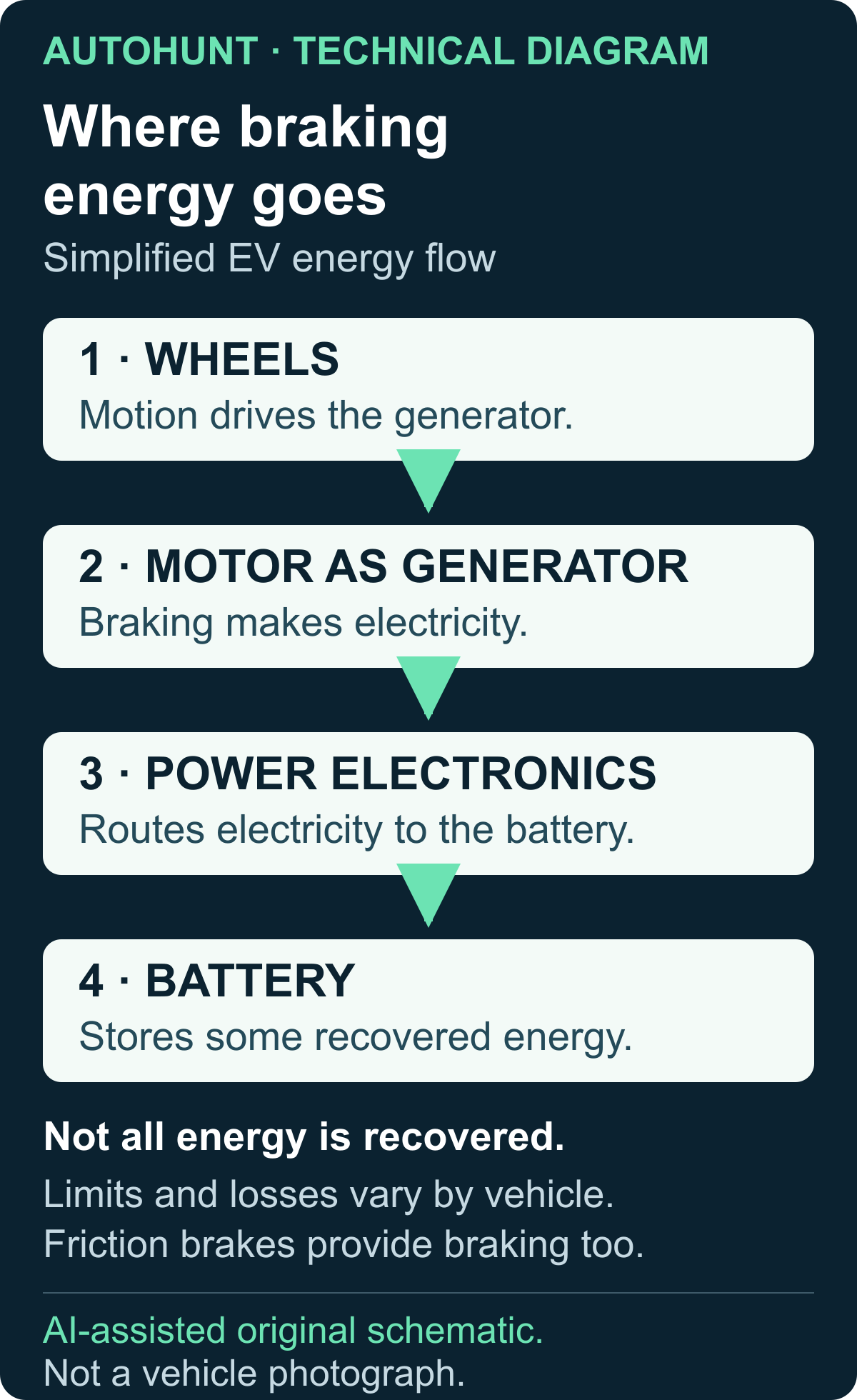
Where braking energy goes
In a battery EV, the motor can act as a generator during deceleration, routing some energy back to the battery through power electronics. Recovery depends on the vehicle and conditions; friction brakes remain necessary. This simplified EV flow does not describe every hybrid layout.
When a mild hybrid fits—and when it does not
Consider it when the underlying petrol car meets your space, price and service needs and you want familiar refuelling. Electrical assistance and stop-start operation are supporting features; assess the whole car rather than buying a badge.
Do not choose it expecting: a plug-in commute, meaningful electric-only range or a strong hybrid’s exact efficiency. A mild-hybrid variant can still be a sensible purchase if its total price and suitability work for you.
When a strong hybrid fits—and when it does not
A strong hybrid deserves a test drive if you regularly face urban stop-start traffic and cannot arrange charging. Its motor and regenerative braking can be useful in that setting, but the actual saving depends on the vehicle and journey.

Do not choose it solely because: a brochure mileage figure looks impressive. A large price premium, low annual use or predominantly steady highway driving may weaken the financial case. Compare the nearest equivalent petrol variant, including equipment differences.
When a PHEV fits—and when it does not
A PHEV can combine a regularly charged daily routine with fuel-backed longer journeys. Check whether the model’s usable electric range covers your route under your conditions, and whether its charging capability matches your parking setup.
Do not choose it for electric savings if you will rarely plug in. An engine backup does not make charging irrelevant. Nor should you assume every PHEV offers DC fast charging or that its overseas specification applies in India.
When an EV fits—and when it does not
An EV is worth comparing when you can make charging a predictable part of life and its usable range covers your ordinary journeys with a margin. For longer trips, plan compatible stops and a fallback; account for weather, traffic, load and charging time.
Do not choose it on a running-cost figure alone if charging would require frequent inconvenient detours. Public charging can be workable, but test the routine before purchase. The DOE’s electric-vehicle overview supplies the basic BEV definition; its US range and incentive examples are not India buying claims.
Home and apartment charging: settle these questions first
- Do you control the parking space, and have the required owner/society permissions?
- Can the installer and electricity provider confirm the electrical capacity, protection, earthing and metering arrangements?
- Who pays for installation, electricity, maintenance and any parking change?
- Does the car support the connector and charging power you plan to use?
- What happens during a power outage, charger failure or a change of rented home?
The Ministry of Power’s 2024 charging-infrastructure guidelines include residential and group-housing contexts. This is planning guidance, not permission for a particular building or DIY installation advice. Obtain an approved installation plan; avoid improvised extension-cable arrangements.

Which choices are actually listed in India?
Current official pages illustrate the categories: Maruti’s Smart Hybrid and Intelligent Electric Hybrid technologies cover different systems; Toyota’s Innova Hycross page lists petrol and self-charging hybrid technology. Mercedes-Benz India’s AMG E-Class technical table identifies the E 53 as a plug-in hybrid. India EV manufacturers also publish model-specific manuals and charging requirements.
These are availability leads, not confirmation of local stock, affordability or delivery. Ask for the India brochure and a dated variant quotation. An overseas PHEV launch, import rumour or preview is not evidence of Indian retail availability.
Running costs: replace these assumptions with your own
The following inputs are invented illustration assumptions, not fuel prices, tested mileage or manufacturer claims. Assume petrol at ₹100/litre, electricity at ₹10/kWh, MHEV efficiency 16 km/l, HEV 22 km/l, and electric use 0.16 kWh/km measured at the wall, including charging losses. For the PHEV illustration, assume 60% of distance electric and 40% fuel at 20 km/l.
| Example | Cost/km | Annual energy cost |
|---|---|---|
| MHEV | ₹6.25 | ₹93,750 |
| HEV | ₹4.55 rounded | ₹68,182 rounded |
| PHEV, assumed split | ₹2.96 | ₹44,400 |
| BEV | ₹1.60 | ₹24,000 |
Petrol cost/km = price/litre ÷ km/l. Electric cost/km = billed kWh/km × tariff. PHEV cost/km = electric-distance share × electric cost + fuel-distance share × fuel cost. Recalculate when the charging share, public tariff or driving pattern changes.
If the HEV costs ₹2 lakh more than the matched MHEV in this hypothetical example, energy-only payback is about 14.7 years at 8,000 km/year,7.8 years at 15,000, or 4.7 years at 25,000. These are scenario estimates, not annual-kilometre purchase thresholds or a forecast.

A full ownership comparison must also include the written on-road price, finance, insurance quotations, service, charger installation and eventual resale. We have not invented depreciation, insurance or battery-replacement costs. Add your own defensible estimates and compare the same ownership period.
Taxes and incentives: check the invoice, not a blanket claim
Policy sources checked 2 October 2026: PIB’s 2025 automobile-sector GST summary distinguishes vehicle classifications. The CBIC tax-information portal also lists subsequent 2026 amendments. An old pre-reform hybrid tax table should not be reused as a current quotation.
We have not completed an invoice-specific legal-rate or state-incentive audit, so this guide does not promise a tax rate or subsidy. Ask for the applicable classification, tax breakdown and your state’s current registration/road-tax rules in writing. Do not assume a hybrid qualifies for a BEV benefit, or that a manufacturing-support scheme is a consumer discount.
Battery warranty and service: compare the actual contract
Read the exact India model’s warranty for time and distance limits, owner eligibility, capacity coverage, exclusions and transfer rules. “Battery warranty” is not automatically a promise of unchanged range. Toyota’s technology page gives its hybrid-battery offer; an EV’s terms may be materially different.
For an example of the detail involved, see Tata’s Nexon EV owner manual. Confirm the manual applies to the version you are buying. Also check nearby authorised high-voltage service support, roadside assistance and the process if a charging fault interrupts travel.
Use model guides after choosing a shortlist
For model-specific details, compare our Grand Vitara guide, Invicto guide, Innova Hycross guide and AMG E 53 guide. Verify any changing specification against the manufacturer before booking.
The BYD Seal U/Sealion 6 preview is a preview, not proof of India availability. Our resale-versus-mileage discussion adds ownership context; future resale remains uncertain.
Quick questions before buying
Does a strong hybrid need home charging?
A conventional non-plug-in HEV does not. Check that the listing actually describes an HEV rather than a PHEV.
Is a PHEV just an EV with unlimited range?
No. It combines two energy systems with model-specific limits. Fuel-backed travel still involves refuelling, and the electric benefit depends on charging and use.
What if I drive only a few thousand kilometres a year?
A large energy-saving premium may take longer than your planned ownership to recover. Comfort, equipment, price and charging convenience still matter.
Which is best for highways?
There is no category-wide answer. Compare your routes, realistic consumption, range, charging stops and the actual cars you can afford.
Sources and editorial scope
Sources are linked beside the claims they support. The decision tree and cost scenarios are editorial tools, not tested vehicle results, tax advice or a personal financial recommendation. This independent guide claims no manufacturer endorsement. Availability and quotations should be rechecked immediately before purchase.